
ECE Regulation
ECE R65 — the rule behind every warning light.
ECE R65 is the European standard that determines whether a rotating or flashing beacon is road-legal. It defines luminous intensity, flash rate, colour and mechanical endurance. Without an R65 mark, a beacon is not allowed on a public road anywhere inside UNECE territory — and insurers routinely refuse claims on vehicles carrying non-approved warning lights.
Laatst bijgewerkt 24 april 2026
What R65 actually measures
The regulation groups beacons by duty class. Class 1: fixed installation, rotating or flashing, used on service vehicles (tow trucks, road maintenance, utility vans). Class 2: heavier duty, used on emergency vehicles (police, ambulance, fire). Class 2 units face stricter photometric requirements and a higher minimum flash rate.
Each class has minimum and maximum luminous intensity specified per angular segment. Too dim is obviously a fail; too bright is also a fail, because it dazzles oncoming drivers. The certification test happens in a photometric lab with the lamp at rated voltage and the chamber at 23°C. Lamps also endure a vibration cycle, IP-water ingress, and a cold-soak at −40°C before photometry is re-measured.
The R65 stamp means the lamp passed three independent tests — optical, environmental and electrical. All three, not any one of them.
Colours — amber, blue, green, red
Amber is by far the most common R65 colour. It signals "caution, work in progress" on recovery, construction and slow-moving machinery. Most of Europe allows amber without a special permit, though some municipalities restrict its use on public roads without a duty reason.
Blue is reserved for emergency services — police, ambulance, fire — and is tightly permitted country by country. Green is used for incident-command vehicles at an active scene. Red is reserved for a narrow set of on-scene roles; its rules vary widely per country.
On a mixed fleet, the safe default is amber with an R65 mark. If you are fitting lights to a vehicle that does not have a statutory right to a non-amber colour, stay amber.
R65 vs. R10 — both stamps matter
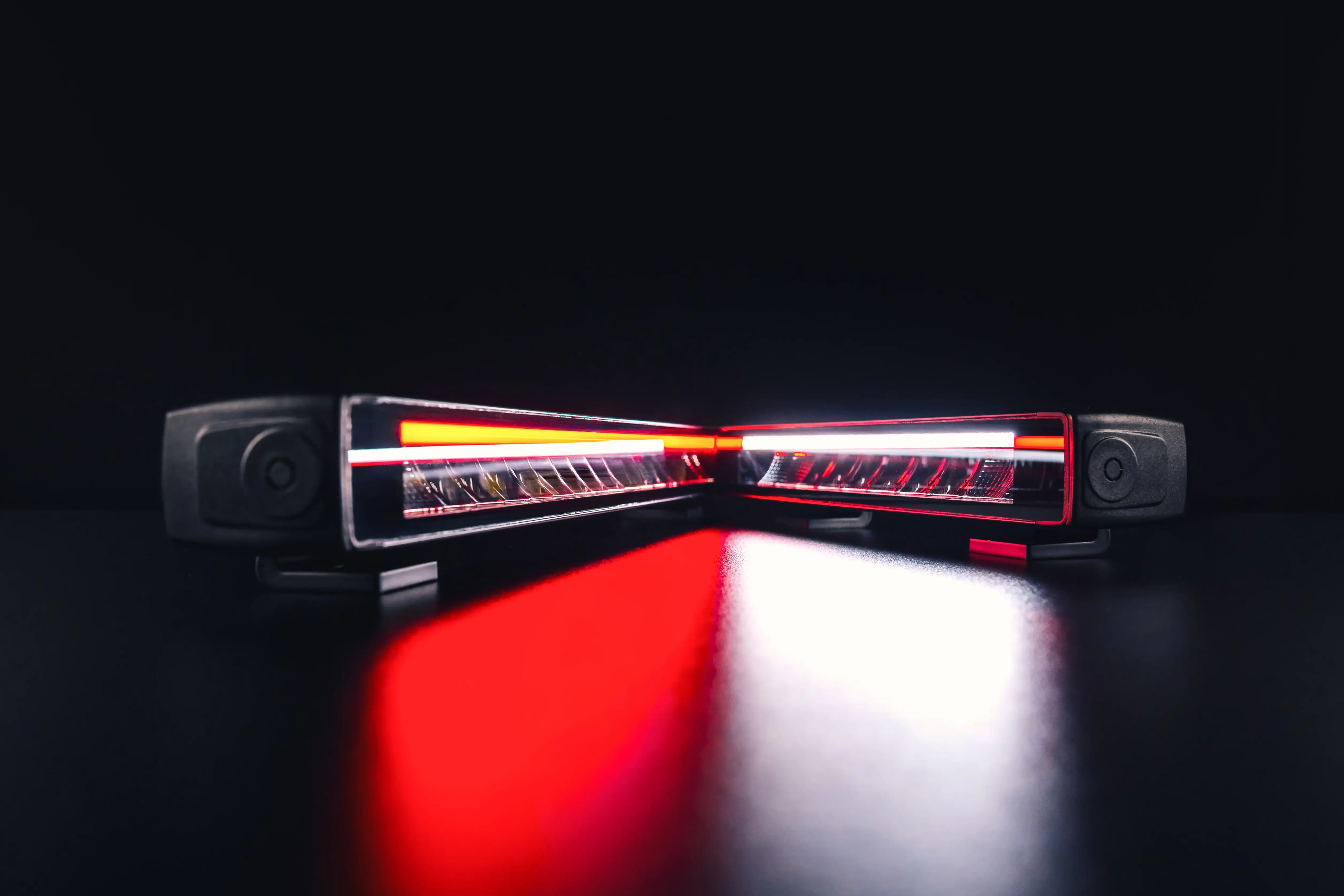
R65 covers the optics and mechanics of the lamp. It does not cover electromagnetic compatibility. For that you need R10 — the regulation that governs electrical interference in vehicle systems. A lamp that flashes beautifully but trips the vehicle's ABS bus on every cycle is not road-legal, R65 stamp or not.
When you buy a beacon from us, check the plate on the underside. A properly certified lamp lists both the E-marks: the circled-E for R65 and a separate circled-E for R10. Only then is it legal to fit without modification.
Flash rate, not just brightness
R65 specifies a flash rate between 2 Hz and 5 Hz (120 to 300 flashes per minute). Faster than that and you get a strobe effect that can trigger epileptic responses in sensitive road-users — it is explicitly forbidden. Slower than 2 Hz and the lamp fails the "obvious warning" test: brains read slow pulses as ambient light, not as danger.
Good-quality LED beacons give you selectable patterns: rotate, double-flash, quad-flash, and a few pre-programmed sequences. All have to stay inside the 2–5 Hz window to keep R65 approval.
What to check when buying
Three items on the product page tell you almost everything you need:
1. The approval stamp. "ECE R65 Class 1" or "ECE R65 Class 2" — the class matters for your use case. 2. Voltage range. 12/24V dual-voltage is standard on professional units, which means no rewiring when you swap a lamp between a passenger vehicle and a truck. 3. Mounting. DIN pole, three-bolt flat, magnetic. Make sure the catalogue image matches the mount on the vehicle; a DIN fitting cannot be bolted through a steel plate without an adapter.
If the product page doesn't list the R65 class and mounting style, move on. The honest sellers put it at the top.
When R65 does not apply
R65 covers warning lights for wheeled vehicles under the UNECE umbrella. It does not apply to stationary equipment (cranes, gantries, traffic cones), to aircraft ground vehicles, or to off-road-only machinery. For those you fall under different standards: SAE J845 in North America, and several national off-road rules inside the EU.
For anything destined to drive on a public road in Europe, R65 is the test, regardless of where the vehicle is registered.