
Vehicle guide · Trucks
Professional LED lighting for Renault Trucks.
Renault Trucks (the Volvo Group's French brand) shares core mechanical architecture with Volvo's FM range but is dressed in a distinct cab and a lighter electrical package. The T, T High, C, K and D ranges target urban distribution, construction and long-haul respectively — each with a slightly different installer-friendliness profile.
Laatst bijgewerkt 24 april 2026
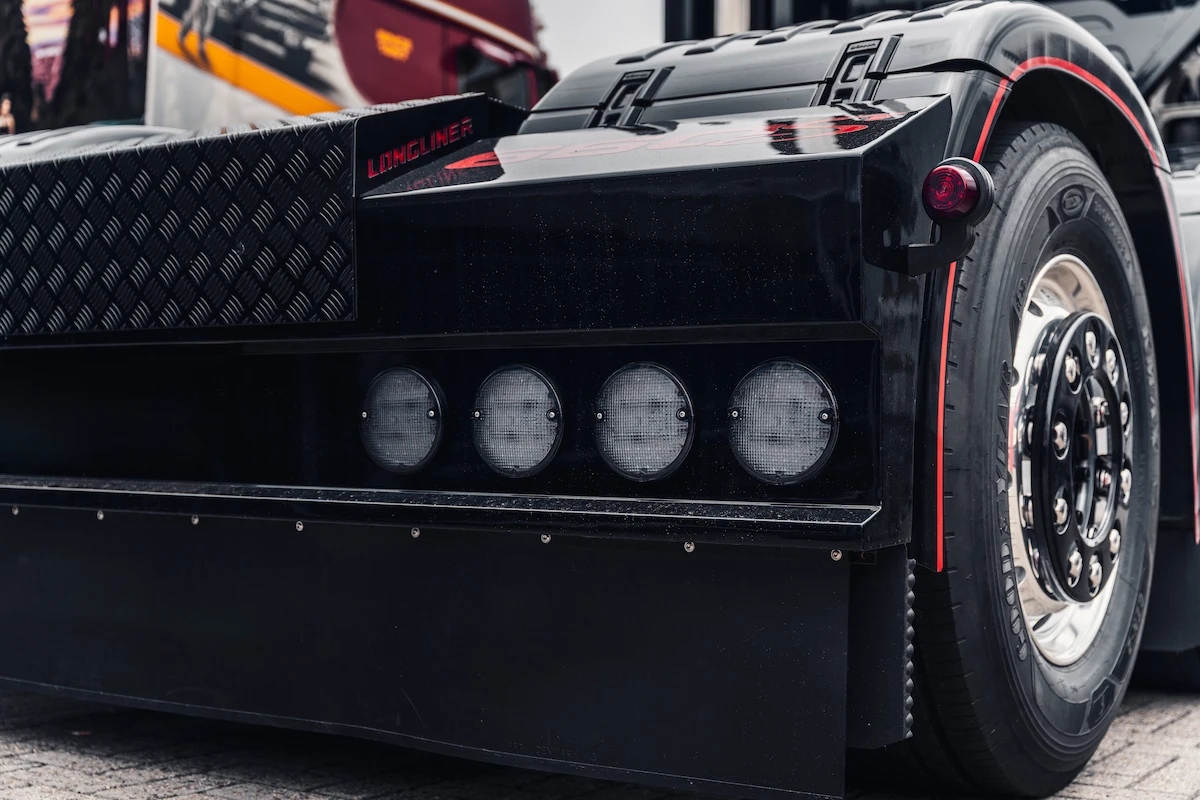
The range — T, T High, C, K, D
The **T** is the flagship long-haul range. Standard or High roof (the High extends the cab profile upward by 300mm). Post-2021 T-Evo update brought a new LED headlamp unit and a revised cab auxiliary fuse block.
The **C** is the construction-oriented derivative of the T chassis. 6×4, 8×4, tippers, mixers. Reinforced front cross-member has factory bolt points for bull-bar auxiliary lights.
The **K** is the heavy-construction workhorse (6×6, 8×6, 8×8). Rarely seen outside construction sites and military-transport fleets. Cab-roof real estate is generous for auxiliary bars.
The **D** covers urban distribution — 7.5 t to 26 t single-axle and twin-axle. The compact cab limits roof-bar options; most beacons fit as DIN-pole mounts from the rear of the cab.
Shared architecture with Volvo — and the exception
Since Renault Trucks joined the Volvo Group, most mechanical and electrical systems are shared with the Volvo FM. That means many Volvo spec notes apply directly: CAN-bus LED rear lamps, VDS wiring routing, Scandinavian cold-start tolerances.
Where Renault diverges: the cab-harness-to-trailer connector. Renault Trucks uses a proprietary 15-pin connector on the T and C ranges, not the Volvo standard. Aftermarket trailer connections require the Renault-specific pin-out or an adapter; the Volvo pigtail is not drop-in compatible.
Renault Trucks uses Volvo internals with French wiring taste. Assume shared, verify before you cut the loom.
Factory mounting points
The T-range cab has pre-threaded M8 anchor points at the roof front for a light bar, and M6 points under the sun-visor for four position lamps. The C and K variants have additional points on the bull-bar brackets for auxiliary driving lamps rated up to 1kg per fixture.
For a warehouse fleet operator fitting twenty trucks, pre-kitting brackets to these factory points keeps install time under an hour per vehicle.
Urban-distribution angle
Renault's D range dominates urban fleets in France, Belgium, and Italy. City restrictions increasingly require low-noise, low-emission vehicles — which drives fleets toward electric or hybrid Renault D-Wide builds. Lighting retrofits on these variants need two extra considerations:
1. Hybrid start-stop: auxiliary lamps must tolerate a brief voltage dip (down to 18V for 200ms) every time the engine cuts. A beacon without brownout protection will flicker at every stop light. 2. Night-mode restrictions: many cities limit amber beacons to "work-in-progress" duty only. Fit a keyed switch on the beacon circuit so drivers can disable it outside working hours.